
TOOLS: Points towards a first printing of SHM91
A working census of typographical variants and editorial corrections in the initial state of the 1991 Edition.
It must have been a profound relief for the 1991 compilers and editors to finally move beyond the aging plates of previous decades. Wholly retypesetting The Sacred Harp offered a rare, clean slate—a chance to purge persistent, long-standing errors, and time-worn plates that had haunted the Denson book for generations. Yet, as any publisher knows, a clean slate is also an open invitation for fresh accidents. While old ghosts were exorcised, the complex process of modernizing the book inevitably introduced a new crop of inadvertent typos and notation quirks at every stage of production. Indeed, at some point in the book’s subsequent history, an acknowledgment was added to Don Bowen “for continuously searching and finding numerous typographical errors in the 1991 revision.”
In my bibliography I’ve designated the 1991 Edition and 2025 Edition of The Sacred Harp as a new work, and defined what that means in another blog post. I have given them, together as a work, the designation of “Sacred Harp, Modern” and the “work code” SHM. Read “Why ‘Sacred Harp, Modern?’” for a fuller explanation.
For the collector and student of shape-note bibliography, the following “points” serve as the primary diagnostic markers for the 1991 Edition, first state. To be classified as a true first state, a copy must contain all of these specific errors; if any of the corrections are already integrated, the volume represents a subsequent printing. However, the task of classification is complicated by the fact that the books themselves carry no internal notation of printing numbers or dates. There is no publicly known errata list, and it remains unknown exactly how many printings have occurred or what specific revisions were introduced between them.
The complexity of these changes is best illustrated by intermediate “drifts” in the text: David Wright and others helped realize, for example, that the poet attribution on page 326 underwent a multi-step correction. Originally listed as “John Leland, 1790,” the year was altered to “John Leland, 1799,” then the name and year to “Caleb Jarns Taylor, 1803,” and finally corrected to “Caleb Jarvis Taylor, 1803.”
Because so little formal bibliographical work has been conducted on these modern editions, this list should be viewed as a working census rather than an exhaustive canon. It is a necessary first step toward charting a territory that remains, for now, largely undocumented. I am grateful to Anne & Thomas Evers, Will Fitzgerald, Peter Schinske, Robert Vaughn, Micah Walter, and David Wright for their input in identifying these variants; as we continue to compare copies, this list will likely evolve. But it is important to gather these now, at this transition point between old and new, before this information is lost.
Please contact me with any notes/corrections/additions:
or use the commenting system:
to provide feedback.
Points of the 1991 Edition (First Printing)
29b Tribulation: The text originally read “Death, ’tis a melancholy day / To those who have not God, / When the poor soul is forced away / To seek her last adore,” which was later corrected to “no” and “abode.”
36t America: The lyrics were originally typeset as a three-verse plain tune, with the first verse under the treble, the second under the alto, and the third under the tenor; this was later changed to place the first verse under all four parts to clarify the fuguing entrances.
63 Coronation: The score is missing the repeat marks and the first and second endings.
85 The Morning Trumpet: In the seventh measure of the bass part, the note was originally printed as a 1-la and later changed to a 7-sol.
166 Still Better: In the eleventh measure of the bass part, the notes on F (4-fa) were corrected to C (1-fa).
109 Carnville: The song title is misspelled as “CARNSVILLLE.”
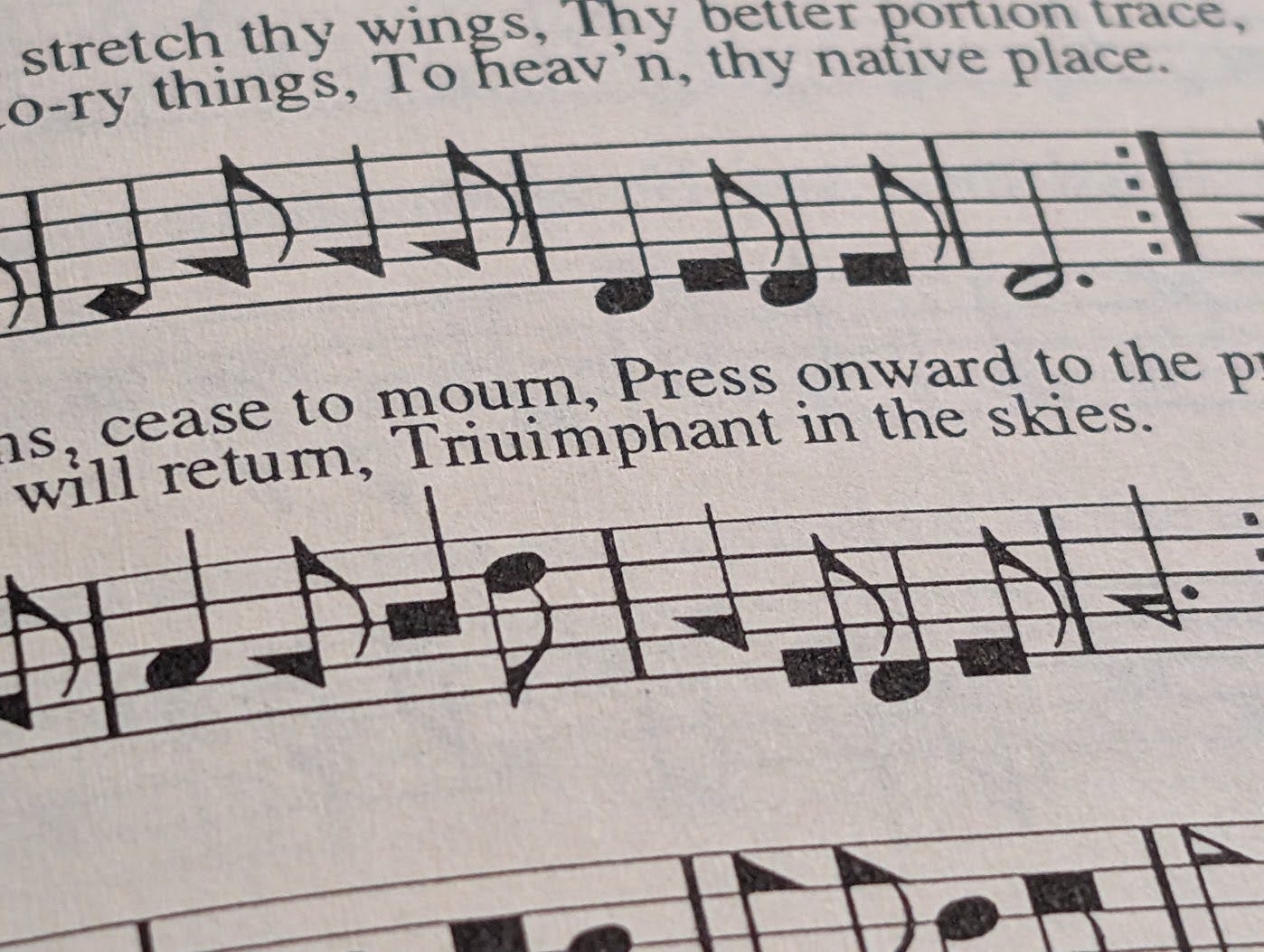
131b Invocation (First): The word “Triuiumphant” in the text was corrected to “Triumphant.”
133 Hebrew Children: In the first measure of the lower brace, the text between the tenor and bass lines was corrected from “those who’ve wased” to “those who’ve washed.”
145 Warrenton: The repeat marks in the second half are placed incorrectly before the rest; in later printings, the correction appears to have been pasted in by hand.
162 Plenary: The lyrics originally read “Hark! from the tombs,” which was changed to the singular “tomb” in later printings of the 1991 (the 2025 Edition has since restored the original plural “tombs”).
179 The Christian Warfare: The first half of the score is missing the required repeat marks.
187 Protection: The designation “SECOND” was erroneously used and later corrected to “FIRST.”
187 Protection: In the first measure of the lower brace, the tenor line originally showed a quarter rest, which was later altered to a quarter note tied to the previous whole note.
189 Montgomery: In the antepenultimate measure of the alto line, a dotted half note is followed by a rest instead of a quarter note, and the words “at hand” are missing from the tenor line.
196 Alabama: The bass line is missing a note in the fifth measure, which should consist of two dotted quarter notes.
225b Christmas Anthem: In the twelfth measure, the bass rhythm was originally printed as two quarter notes and was later corrected to a dotted quarter followed by an eighth note.
242 Ode On Science: The title on page 242 was originally printed as “Ode To Science,” though pages 243 and 244 were correct.
300 Calvary: The word “ruins” occasionally appears instead of “ruin” in the second half, and the first instance of “her sovereign Death” in the alto line mistakenly reads “here.”
310 Weeping Savior: The designation “FIRST” was erroneously used and later corrected to “SECOND.”
320 Funeral Anthem: The score originally included an end repeat directing the singer back to the 3/2 section; this repeat was removed in later printings.
326 Weary Pilgrim: The poet attribution was originally listed as “John Leland, 1790” before being altered to “John Leland, 1799”, then to a “Caleb Jarns Taylor, 1803” and then finally corrected to “Caleb Jarvis Taylor, 1803.”
342 [Page Number]: The page number is printed on the inside margin rather than the outside margin.
344 Rainbow: The word “years” appears throughout the text and was later corrected to the singular “year.”
348 Ainslie: The song title is misspelled as “Anslie.”
371 Heavenly Dove: The first two lines of the second verse were originally printed as “Come, Holy Spirit, heav’nly Dove / With all Thy quick’ning pow’rs” before being changed to “In vain we tune our formal songs, / In vain we strive to rise”; this revision was in place by early 2010, but later reverted to the original.
378 Heavenly Port: The lower choice notes are missing from the fifth measure of the alto line.
404 Youth Will Soon Be Gone: The second measure of the tenor line incorrectly uses a dotted quarter and an eighth note instead of two quarters and a half note.
428 World Unknown: In the sixth measure of the lower brace, the slur in the bass line originally extended to the first quarter note before being corrected to reach the second quarter note.
430 Arbacoochee: The end of the first line in the tenor part uses the word “when” instead of “His,” and the subsequent correction uses a lowercase “h” despite other parts being capitalized.
448t Consecration: The fifth measure originally contained a dotted half note, which was later lengthened to a dotted whole note.
448t Consecration: The alto choice note (3-fa) on the word “with” was removed in later printings, a change implemented by late 1996 or early 1997.
450 Elder: The chord on the word “rude” in the fifteenth measure was altered in later states of the edition.
456 Sacred Mount: The seventh measure of the lower brace originally featured a slur connecting the first three notes of the bass line; this slur was removed in later printings.
466 Haynes Creek: The alto line in the fugue incorrectly reads “Our knees have often bent, And God bent” instead of “Our knees have often bent, have often bent.”
467 Lisbon: The opening whole rest—which correctly fills the 3/2 measure—was erroneously changed to a half rest in later printings. This was likely an unintended consequence of attempting to correct the physical placement of the whole rests, which originally hung from the second line of the staff rather than the middle line.
480 Redemption: The tenor rhythm in the third measure was originally two quarter notes; this was corrected to a dotted quarter and an eighth note, a change believed to have been implemented by late 1996 or early 1997.
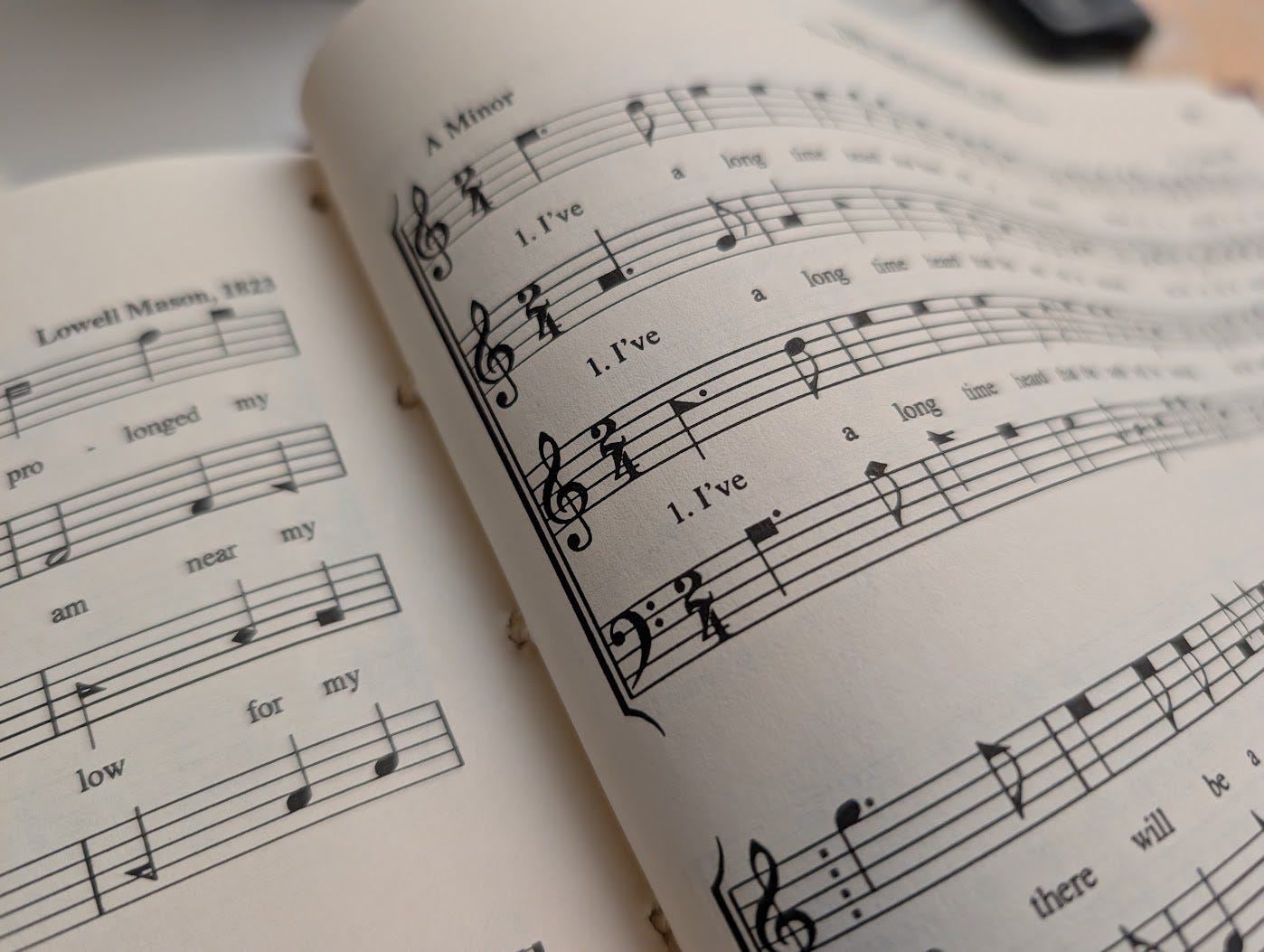
517 Mars Hill: The key is incorrectly identified as E Minor instead of F Major.
556 Portland: The beginning of the second verse in the bass fugue incorrectly reads “And ev-’ry pow-er” instead of “And ev-’ry pow’r find.”
560 My Home: The title is missing the design
ation “(Second).”
567 The Great Day: The number “1.” is repeated for every verse instead of following the correct “1. 2. 3.” sequence.
Just have to say, Thomas Evers contributed as much as I did.