
TOOLS: Shape-Note Tunebook Identification System
Three-letter work codes, edition years, and variant nicknames — a practical method for identifying tunebooks across editions and printings. (rev. 05/24/2026)
NOTE: This post consolidates and supersedes two earlier posts: the original TOOLS: Shape-Note Tunebook Identification System (Dec 4, 2025), which established the three-layer naming structure, and a draft “Work Codes” post derived from the second half of TOOLS: Bibliographical Terminology for Shape-Note Tunebooks, which added rhetorical framing and case-study material. The two posts were doing related work on the same system and have been merged here.
In writing about tunebooks, researchers and singers commonly rely on abbreviations to reduce repetition and to distinguish among titles. Many initialisms are used in social media posts and flyers about singings, or track listings on albums.
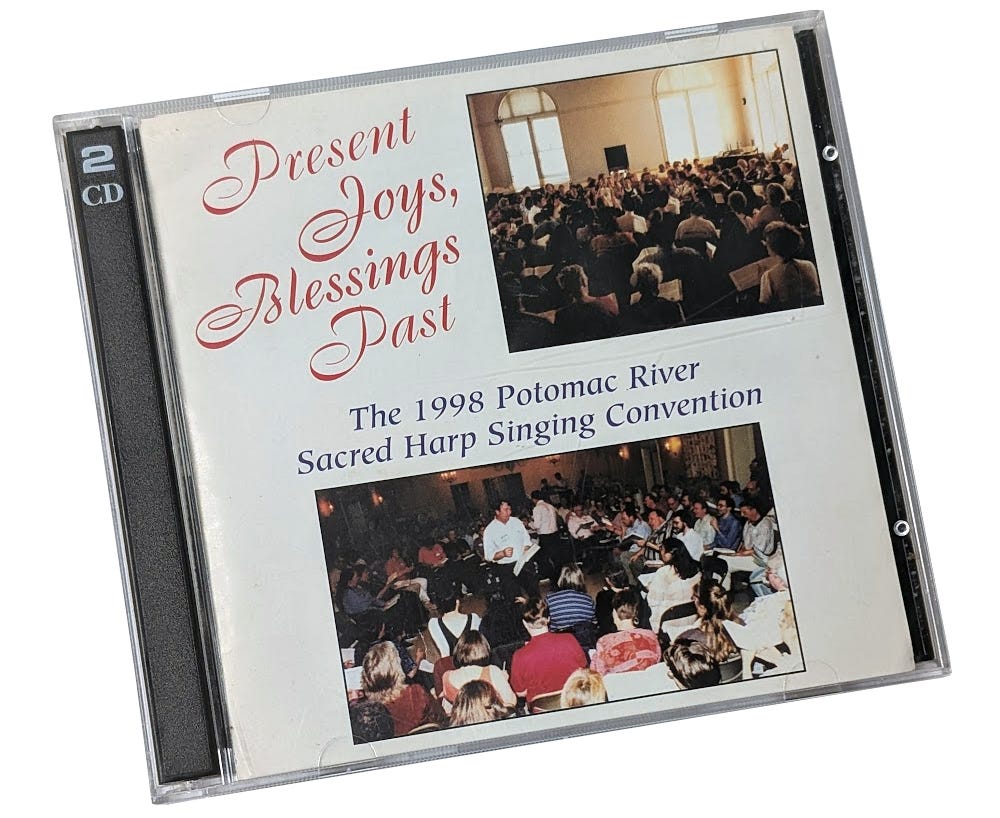
I recently obtained “Present Joys, Blessings Past: The 1998 Potomac River Sacred Harp Singing Convention,” a two-disc CD released in 1999 by the Folklore Society of Greater Washington. On the back cover is a track listing that includes the following codes:
SH: The Sacred Harp, 1991 Edition
CSH: The B.F. White Sacred Harp, 1992 Cooper Edition
NT: New Traditions Singing1
The first CD is solely The Sacred Harp, 1991 Edition; the second disc contains tunes from other sources.
I have adopted such a system in my own work, using a three-letter work code followed by a four-digit edition year and, when useful, a descriptive variant nickname. These codes appear throughout this bibliography and across my other projects at SingLoud.
This post explains how the system works, walks through the rationale for a few of the trickier coding choices (including the use of “SHM” for the 1991 Edition of The Sacred Harp), and provides examples and guidelines for applying it consistently.
Purpose
This system was developed primarily for my own cataloguing work: to bring clarity and structure to the many shape-note tunebooks that are often inconsistently documented. While it is shared here for the benefit of others, it is not intended as an academic bibliographic standard — rather as a practical tool.
The system allows:
Clear communication across formats (print catalogs, event booklets, footnotes, metadata forms)
Accurate bibliographic tracking of distinct tunebook works, editions, and variant printings
Room for historical nuance and community-driven discovery (e.g., informal Variant Nickname adoption)
It is designed to be scalable, research-friendly, and accessible to both scholars and singers. In practice, I have found the codes especially useful as the basis for filenames of book photographs.
Because no universally accepted abbreviation system exists for shape-note tunebooks, the potential for confusion is high given overlapping titles and traditions. The system here is built specific to my research and documentation. My main inspiration has been the way titles are shortened in the annual Sacred Harp Minutes books, as well as the work of musicologist George Pullen Jackson, whose writings initiated the scholarly appraisal of these tunebooks. I was initially hesitant to deviate from the established abbreviations found in those sources, and I only did so when I had a strong reason for creating a new or clearer code.
While most tunebooks were printed only once or in a single edition, a small but significant number have been printed repeatedly across decades — and sometimes centuries — with notable changes in content, engraving style, pagination, binding, or regional imprint. This system is designed to identify such tunebooks clearly, while remaining simple and flexible enough to handle both single-edition works and long-running publication histories.
The complete reference is the Master Work Codes post, the first on this blog.
System Structure Overview
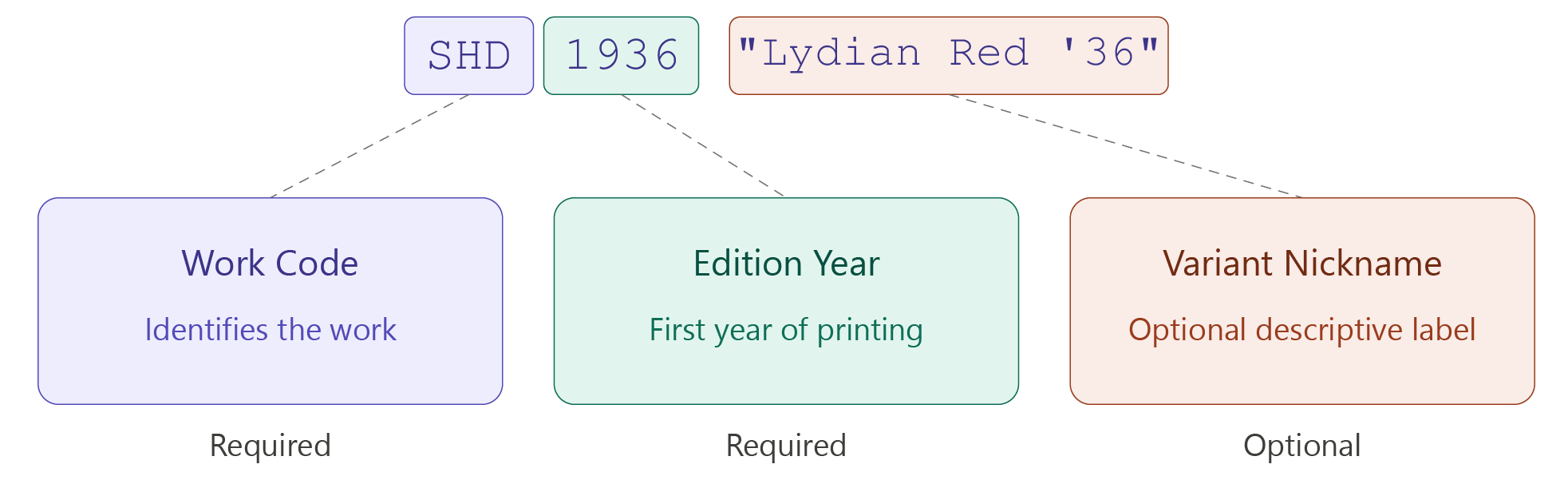
Each tunebook reference is built from three layers, listed below from most general to most specific:
Work Code
Edition Year
Variant Nickname (optional but encouraged)
Together, they form the full, unique identifier for a tunebook instance.
Example:
SHD1936 "Lydian Red '36"
This refers to:
SHD — The Sacred Harp (Denson Revision)
1936 — 1936 Edition
“Lydian Red ‘36” — a distinct Variant Nickname used to identify a particular printing/binding
Work Code
A three-letter code used to uniquely identify the tunebook as a work, regardless of its editions or printings. For tunebooks issued only once (i.e., without significant later revisions), this code alone is sufficient for identification.
Guidelines
Work Codes are three letters long and should be mnemonic (based on the title) whenever possible. When conflicts arise (e.g., multiple books with similar initials), the following strategies may be used to retain uniqueness and recognizability:
Use the compiler’s last initial to differentiate similar titles when needed (e.g.,
SHDvs.SHJ).If necessary, introduce a lowercase letter from the interior of the title to preserve mnemonic value (e.g.,
EaIfor The Easy Instructor orNoHfor Northern Harmony).If all preferable combinations are exhausted, select an interior letter to maintain uniqueness — but avoid using letters not found in the title whenever possible.
Abbreviations should remain unique, mnemonic, and consistent.
Avoid using lowercase “l” and uppercase “I” when possible, as these can be hard to distinguish in some typefaces.
Upper- and lowercase letters are permitted, but no code should rely on case sensitivity. (In other words: do not repeat codes that differ only by case.)
I have tried to avoid conflicts by using internal lowercase letters when needed (e.g.,
SoHfor Southern Harmony,ShHfor Shenandoah Harmony) to ensure each code is distinct.Work Codes refer only to the work — not to a specific edition or variant.
A master list of assigned codes is maintained at SingLoud.org and in the Master Work Codes post.
Example Tunebook Work Abbreviations
With first edition year:
CSH: Colored Sacred Harp, 1934
EaI: The Easy Instructor, 1801
NoH: Northern Harmony, 19802
SHB: The Sacred Harp (B. F. White), 1844
SHC: The Sacred Harp (Cooper), 1902
SHD: The Sacred Harp (Denson), 1936
SHJ: “Original Sacred Harp” (James), 1911
SHM: The Sacred Harp (Modern), 1991
SHW: The Sacred Harp (J. L. White), 1911
ShH: The Shenandoah Harmony, 2013
SoH: The Southern Harmony, 1835
UCH: Die Union Choral Harmonie, 1833
VaH: The Valley Harmonist, 1836
VPH: The Valley Pocket Harmonist, 2024
Note on The Sacred Harp
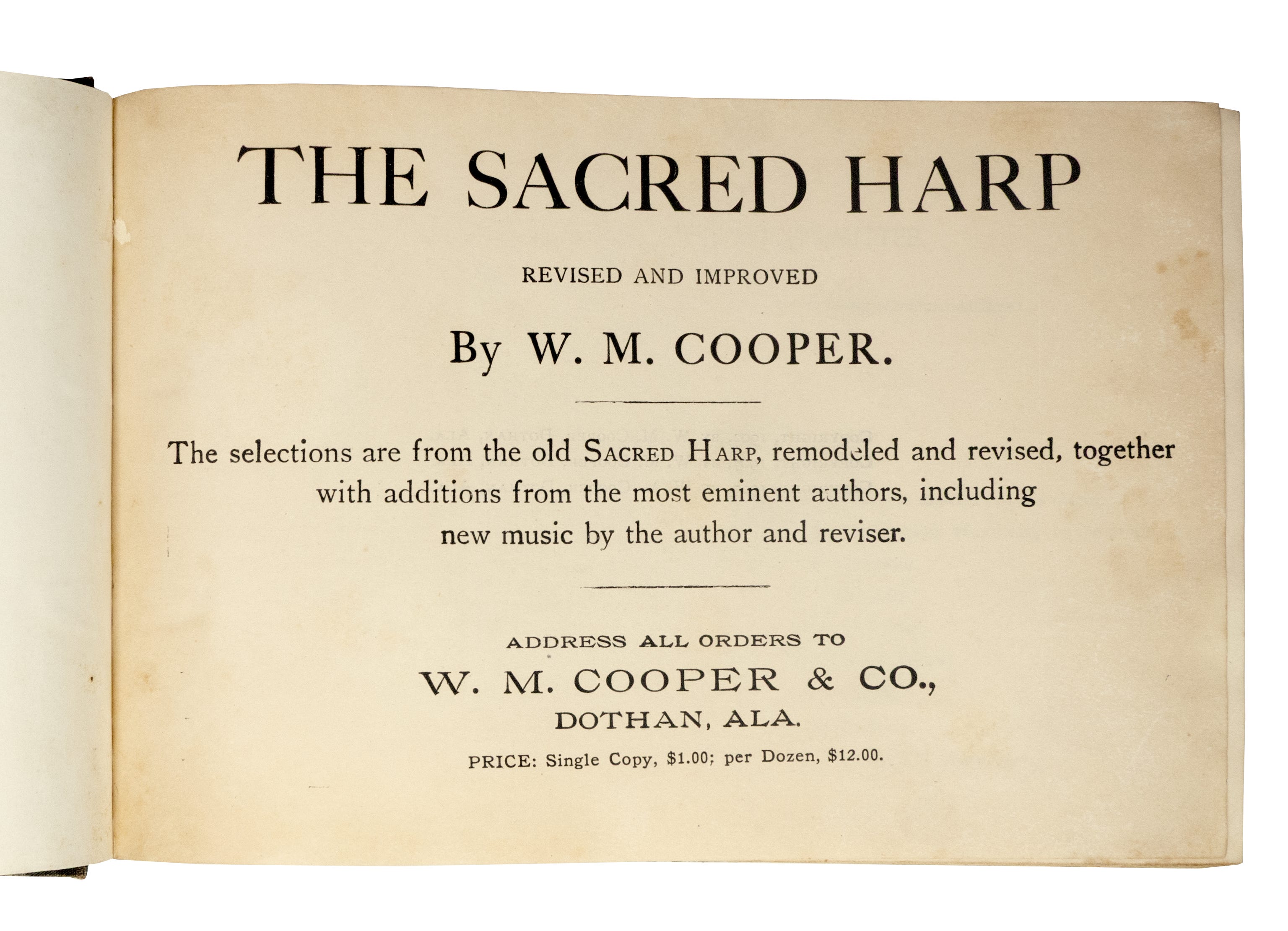
Special consideration was given to The Sacred Harp. The lineage launched by White and King in 1844 has evolved through several major editorial branches — the J. L. White, Cooper, James, Denson, and Modern lines — each warranting its own code.
Additionally, several tunebooks carry “Sacred Harp” in the title with no editorial connection to the White and King lineage at all. The work codes distinguish these from the main lineage.
Within the main lineage, titles have shifted: J. S. James released his work as “Original Sacred Harp” (with quotation marks), a title retained by the Denson brothers and used right up to SHM1991, the 1991 Edition. The SHC line changed titles from The Sacred Harp to The B. F. White Sacred Harp when publishing moved to Troy, Alabama, in 1949.
Edition/Print Year
A four-digit year is appended to the Work Code to identify the first year of printing for a specific edition. When a tunebook lacks an explicit edition statement, this year represents the earliest reliably inferred print date for that state of the book.
When I need to refer to a particular edition of a work, I append the four-digit year of that edition. For instance, SHD1936 would indicate the 1936 edition of the “Denson Revision” of The Sacred Harp, while SHD1960 would indicate the 1960 edition in that same work lineage.
While some editions of a work exist in multiple states, I have not assigned codes at that level of granularity for my exhibit or this guide. The order of state emergence is often unclear, and such fine distinctions exceed the scope of this more universal tunebook coding system. Distinctions among states are handled through the Variant Nickname layer, described below.
Uncertain Dates: The EDTF “X” Convention
For approximate or uncertain years, this system adopts the Library of Congress Extended Date/Time Format (EDTF) convention in which unspecified rightmost digits may be replaced with the character X. This preserves the four-digit structure of the Edition/Print Year element while expressing graded uncertainty through controlled truncation. Thus, 193X indicates an unknown year within the 1930s, and 19XX indicates an unknown year within the twentieth century. When the century itself cannot be determined, the year is recorded as XXXX rather than a partial form such as 1XXX, to avoid implying precision that does not exist. Within this system, XXXX functions as a defined placeholder signifying that no chronological inference — not even century — can be made. This is a deliberate departure from strict EDTF practice, but it maintains the uniform four-character requirement for this field.
This method eliminates appended qualifiers (e.g., “c.” or “ca.”) and ensures fully sortable, machine-readable uniformity across identifiers. Only numerals and the X-character appear in this element; broader narrative explanations or evidentiary notes regarding date uncertainty should be recorded in descriptive metadata rather than within the Edition/Print Year itself.
If the exact year is unknown, the identifier varies based on certainty:
Variant Nickname (Optional)
A Variant Nickname is an optional, human-friendly label used to distinguish meaningful variant printings or “states” within the same edition. Variant nicknames are descriptive rather than standardized — different people may use different terms, and usage may evolve over time. While not ideal in terms of rigidity or precision, this flexible approach adds just enough clarity to help identify distinct states in a tunebook’s publishing history without overloading the core naming system.
Examples
SHD1936 "Lydian Red '36"— bound in distinctive red clothSHD1971 "Marbled Book"— marble-like printed paper over boards bindingEaI181X "Albany Engraving"— engraving attributed to Albany publisher
When to Use a Variant Nickname
A tunebook has a distinct physical or textual variant (e.g., binding, pagination, engraving differences)
The variant is recognized or referenced by collectors, singers, libraries, or publishers
It enhances clarity in cataloging, exhibition, or collector conversations
Guidelines for Creating Variant Nicknames
Keep it short, descriptive, and intuitive
Base it on clear, observable traits (binding type, engraving, known publisher, etc.)
Place it in quotation marks immediately after the
WorkCode+Year(e.g.,SHD1936 "Lydian Red '36")
Why Not a Numbered State Code?
I have intentionally not included a numbered state or version code in this system. Such a code would either have to be random, mnemonic, or strictly chronological — and none of those options are satisfactory. A random or purely mnemonic code doesn’t convey meaning; a chronological sequence is fragile, since many print states can’t be confidently dated in sequence. New discoveries may also fall “between” known states, making any numbering system both arbitrary and unstable. Instead, this system uses the optional Variant Nickname to keep distinctions meaningful without false precision.
Full Work Code + Year + Nickname Examples
SHD1936 "Lydian Red '36"
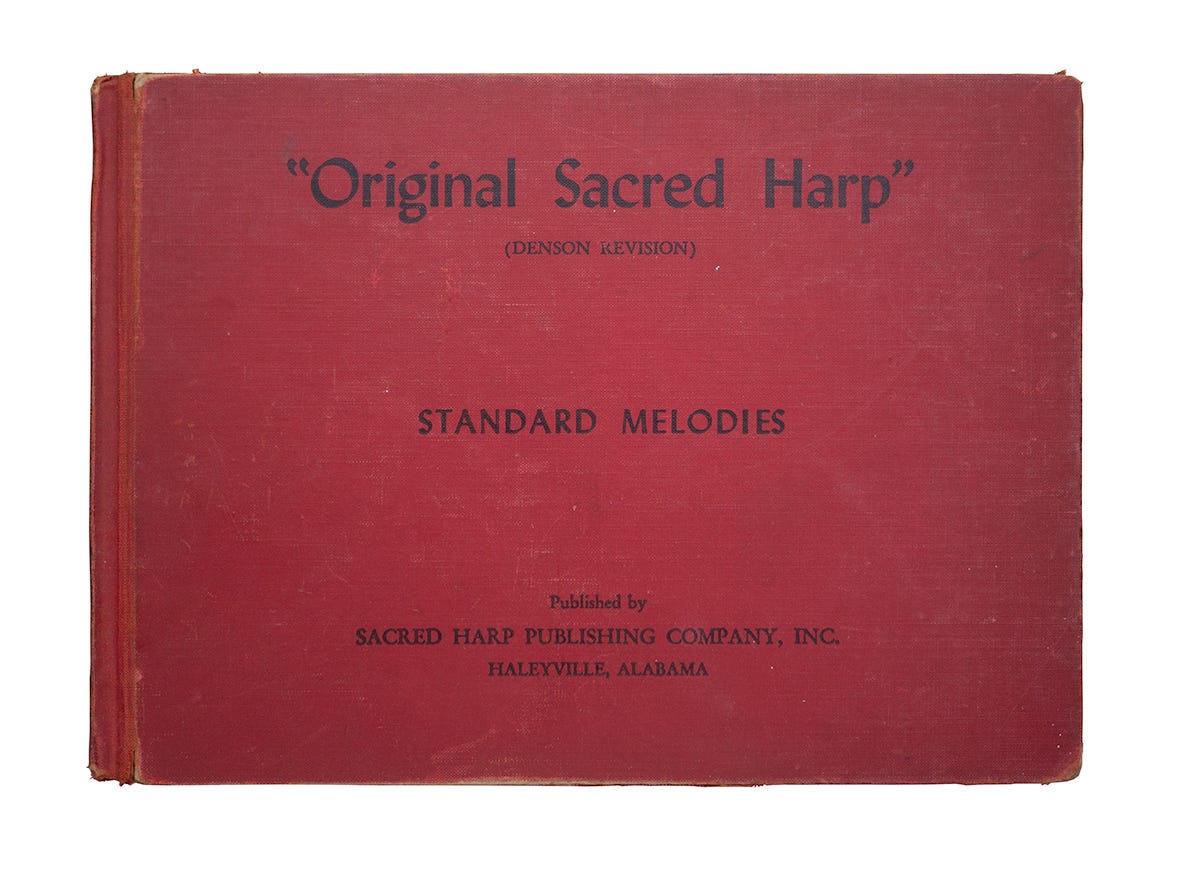
SHD = The Sacred Harp (Denson Revision)
1936 = First year of the first Denson-edition printing
“Lydian Red ‘36” = Variant nickname used to distinguish a printing with bright red cloth binding and the title in the “Lydian” typeface
SHM1991
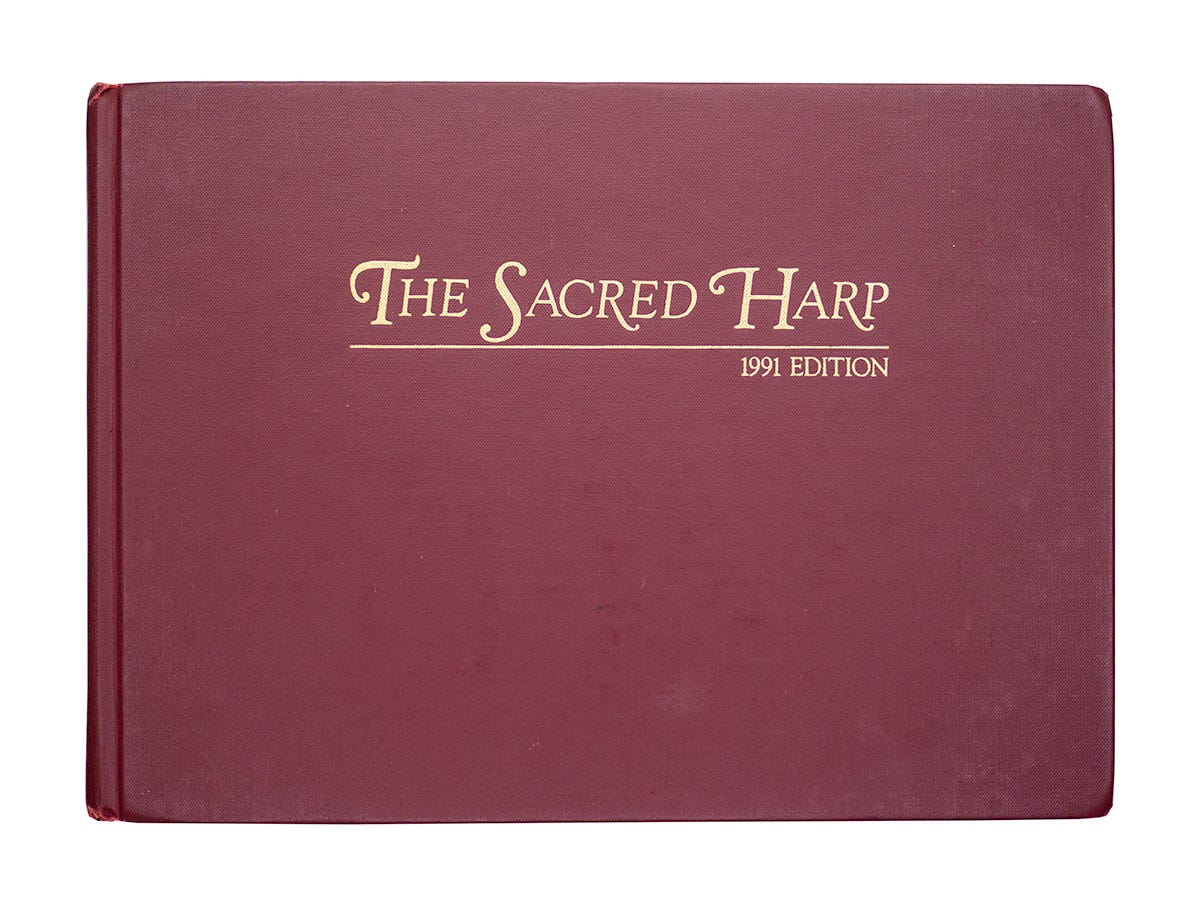
SHM = The Sacred Harp, Modern — the retypeset work introduced in 1991
1991 = First year of printing for this newly revised edition
This entry does not include a Variant Nickname because none is needed. The Sacred Harp: 1991 Edition exists in only one undifferentiated edition, even if multiple variant states have occurred. See TOOLS: Points towards a first printing of SHM1991.
Key point: Avoid adding a Variant Nickname when it does not meaningfully disambiguate between states. Use it only when it helps differentiate a specific, identifiable version within the same edition.
EaI181X "Albany Book"
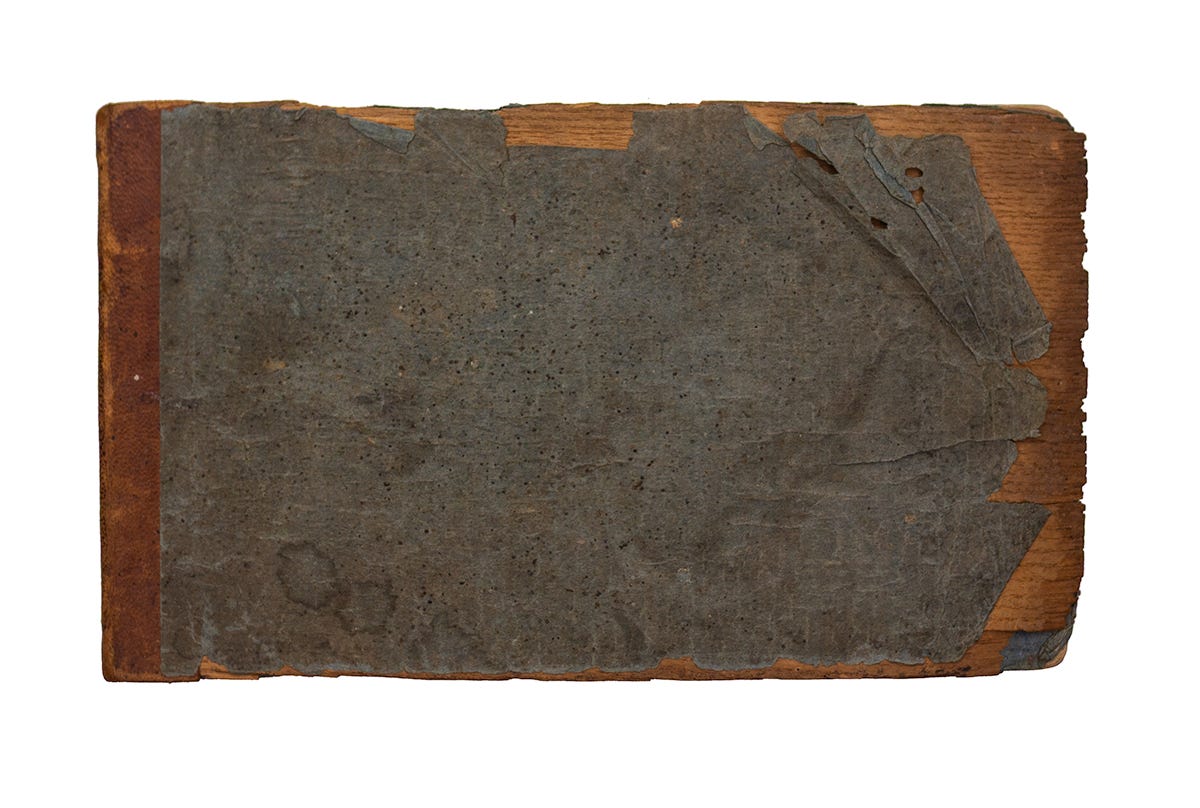
EaI = The Easy Instructor
181X = Printed within the 1810s (exact year not confirmed)
“Albany Book” = Nickname referring to where the book was printed. While it doesn’t disambiguate all states of this work, it narrows its place in the printing history. I haven’t done enough work to meaningfully give nicknames for these states, so I might hesitate on using this outside of an example.
Quick Decision Flow
Question: What year should I append to the Work Code?
Is there a formal edition date clearly stated? → Yes → Use it (e.g.,
SHJ1911,CHM2010)If not, can the print year be determined or reliably inferred? → Yes → Use the year, with “X” or “XX” if approximate (e.g.,
EaI181X)If neither applies: → Use “XXXX” and clarify known context in notes
Should I add a Variant Nickname?
Yes, if it helps distinguish a specific printing or physical state within the same edition.
No, if the copy is typical or undifferentiated.
Case Study: Why “Sacred Harp, Modern”
For years, I referred to the 1991 Edition simply as a “Denson Book,” echoing the colloquialisms of the singing square. However, closer scrutiny reveals a work that earned its own distinct work designation. While it descended from SHD1936, the 1936 Denson Revision, SHM1991 was a thorough reimagining — retypeset, expanded, and notably stripped of “Denson” on the title page to signal a broader editorial collaboration. Because these works are intentionally not identified with a single reviser, I have designated this work as SHM for Sacred Harp, Modern.3
In classifying these works, I have had to weigh the tension between scholarship and practice. Compilers are often desperate to bridge this gap, as publishing such a niche work requires an immense investment of time and capital. Yet, intent matters:
SHJ2015(“Original Sacred Harp:” Centennial Edition) — While singable, this was prepared with a lean toward scholarly preservation.SHM1991(The Sacred Harp: 1991 Edition) &SHM2025(2025 Edition) — These are unapologetically vehicles for the “hollow square.”
SHM2025, in particular, leans even further into its identity as a harmonized tunebook for active use. It utilizes modern typesetting and book design sensibilities, yet these choices aren’t arbitrary or modern for modernity’s sake. Instead, the editors often reach back into tunebook history to inform contemporary aesthetics. Traditional aspects are retained — not out of rigid adherence to the past, but because they cultivate the unique idiom and history of shape-note singing. The result is a book that feels both historically grounded and technically evolved; it is modern in the best sense of the term.
See Also
The complete reference is the Master Work Codes post — the first on this blog.
Revision History
2026-05-24 — Consolidation of two posts. This post combines the original TOOLS: Shape-Note Tunebook Identification System (Dec 4, 2025), which established the three-layer naming structure, coding guidelines, and EDTF “X” date format, with material from a draft “Work Codes” post (originally the second half of TOOLS: Bibliographical Terminology for Shape-Note Tunebooks, Feb 9, 2026), which contributed the Potomac CD opening, the editorial-branch framing for The Sacred Harp, and the “Sacred Harp, Modern” case study. The merged post is now the canonical reference for the identification system.
2025-12-11 — Adoption of LoC “X” Unspecified-Digit Year Format. The Edition/Print Year element now follows the Library of Congress Extended Date/Time Format convention for representing uncertain dates by using X in place of unknown rightmost digits. This change replaces the previous suffix system (”c” for circa, “s” for broad century estimates, and “0000” for unknown) with a single, uniform mechanism that expresses all levels of year uncertainty within the existing four-digit structure (e.g., 193X, 19XX, XXXX). This resolves the problem of appended qualifiers expanding the total code length beyond the intended seven alphanumeric units, restores strict uniformity across all identifiers, and provides a clearer, more intuitive representation of approximate dating. The system now communicates uncertainty solely through controlled truncation of the year, while retaining full compatibility with sorting, indexing, and machine readability. My gratitude to Will Pertain for the suggestion.
Footnotes
New Traditions Singing. “New Traditions Singing” is a term for when a special session was made for new compositions and tunes from a source that is not the main book of an All-Day singing. This tradition, begun in 1997 and apparently ended after 2010, was part of the Potomac River Convention and appears in North Carolina, as per the Minutes.
A definition of sorts is gleaned from an announcement from the Folklore Society of Greater Washington about a forthcoming All-Day:
“The Saturday evening social will follow the singing on site. Come for the potluck dinner provided by local singers, conversation, and cheer, and at 6:30 PM join the New Traditions Singing of new songs or songs from tunebooks other than The Sacred Harp, 1991 Edition.”
The 2010 Potomac minutes are interesting:
After some singing from the Missouri Harmony brought by John del Re, Tim Slattery opened the New Traditions session. Leaders: Terry Ryan “Harvest Hymn”; Mary Ann Daly “Roby,” “Forty-Sixth”; Rachel Hall, “Fresh and Green”; Mimi Stevens “Refreshment,” “Arbour Hill”; Nicholas Schliapin “Life,” “Elijah”; Tim Slattery “Willard”; Mary Ann Daly “Mount Watson”; Mimi Stevens “Ogontz,” “Cyrus”; John del Re 172, 58, 69 (MH); Robin Betz 323t.
Code change: NoH replaced NtH. “NoH” replaced “NtH” in a recent revision to the Master Work Codes list.
CHM and the Christian Harmony aside. A parallel rationale led me to use CHM for The Christian Harmony: 2010 Edition, or Christian Harmony, Modern. As a seven-shape book it is outside the scope of my immediate bibliographical work. This also complements the Heritage Edition, the other in-print version of The Christian Harmony.